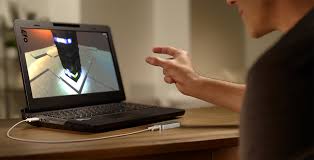
 Leap motion is a device that allows input to a PC/Mac via hand and finger motion without the need to touch anything (open space). This is plugged into your USB port and it begins working with any Leap-enabled software. Only the specialized applications that have the compatibility are able to use Leap motion. All of the compatible applications can be found on their sub-site 'Airspace'. They have an assortment of categories to choose from, e.g. Games, Educational, Scientific. The creative tools found in the App Store seems to be quite unique, and the artistic/design skills involved seem very immersive.
Looking at the capabilities of Leap Motion, it could potentially lead to a new way of working with devices. This is especially prominent in the field of gaming and creative 3D designing. Therefore I feel this device will more than likely be aimed at Gamers and 3D designers. At its current stage it seems quite limited with its versatility.
Leap Motion Introduction Video
 Cybertecture Mirror is a mirror monitor that is digitally displayed. It is the first of its kind to produce a visual display, on a mirror, with many applications to run at its disposal. The mirror is of a standard size (80 x 50 x 5 cm) and can be put anywhere in the house, where appropriate. The interface is mainly controlled by a separate device (remote control or smartphone), but does incorporate some other forms of interaction (e.g. motion detection, voice recognition). The interface is also customisable, allowing for different choices in display themes, to the overall layout of the display. There are various applications available for the Cybertecture Mirror, some keeping you up to date on the latest News and Weather. But the main applications seem to be based around Health/Fitness. One of them involves lifting weights, whilst the mirror monitor checks to see if your posture and arms are positioned correctly (uses lines to guide you). There is also an add on which can check your weight and keep a record of it, to see how you've progressed. All of this data will be stored via cloud storage.
Personally, I find this device to be quite a Novelty. Most of today's applications are available from pretty much any device, and it seems to be quite unnecessary to have this attached to a mirror. However, if you are a tech fanatic or person who likes to keep in shape, this is probably for you. The interface is quite slick, and is definitely a benefit for someone who likes to keep track of their fitness. Ideally, the designers created this mirror to be used in the bathroom, as it has waterproof protection. Overall I must say, the quality of the design is very good, but its usefulness seems to be somewhat lacking.
Video Link
Paradrome is a unique paragliding simulator. It is extremely effective at producing a realistic experience for the user, by having an interactive design that allows you to move as if you were actually Paragliding. The features of the simulator include: a seat, a harness and two pulleys. Once strapped in, you can function the para-glider by simply pulling on the two pulleys (right and left). The movement of the wings is affected by how fast and how much you pull them, e.g. for a sharp turn, pull long and fast.

You will be given a set course to complete, which will needed to be done within at least 5 minutes. The environment/setting around you will be volcanic, where you will need to weave in and out of the lava crevasses to reach the top of the volcano (as demonstrated in the video clip below). Depending on how fast you complete the course, you will be rewarded either with a Gold, Silver or Bronze medal (gold being fastest, bronze being slowest).
I believe Paradrome is appropriate for any age group. However, I feel it is more appropriate for people above the age of 16, who have a particular interest in extreme sports or specifically paragliding. I personally find that it would be very good for training purposes and also for those who are scared/wary of the heights involved. If the simulation were to be improved (although not needed), it could include wind factors with a blower to simulate the affect.
A video demonstration of Paradrome


